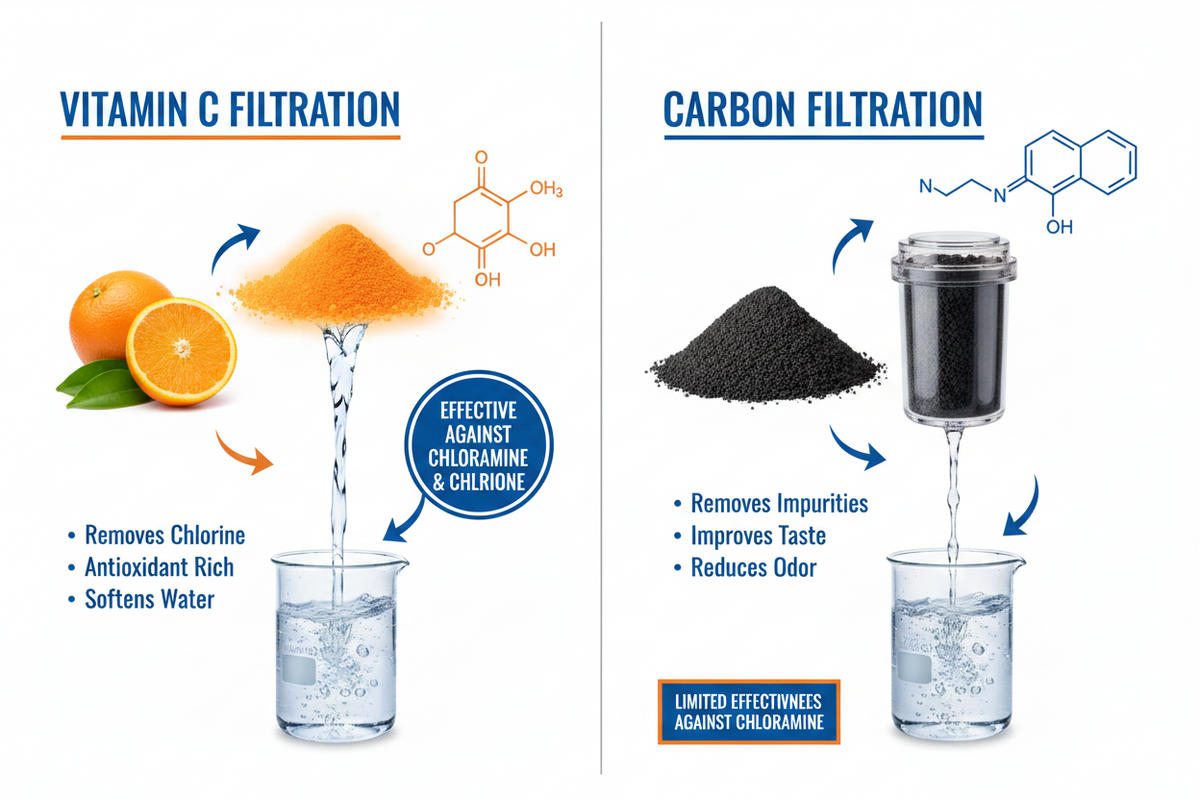
Vitamin C vs. Carbon Shower Filters: Which Is Better?
If you are shopping for a shower filter, you will probably see two popular options: carbon shower filters and Vitamin C shower filters.
Both can be useful, but they are not exactly the same.
Carbon filters and Vitamin C filters work in different ways, and the best choice depends on your water, your shower setup, and what you want the filter to do.
At AquaYouth, we offer both options because different customers have different needs.
This guide explains the difference between Vitamin C and carbon shower filters so you can choose the best option for your shower.
The quick answer
A carbon shower filter is usually the best choice if you want a traditional filtration system focused on reducing free available chlorine and improving overall shower water quality.
A Vitamin C shower filter is often a good choice for customers who want fast chlorine and chloramine neutralization, especially in a handheld shower format.
Both options can help improve the shower experience, but they work differently.
What does a carbon shower filter do?
Carbon is one of the most common filtration materials used in water filters.
In shower filters, carbon is mainly used to reduce chlorine, odor, and certain impurities that may affect how shower water smells and feels.
AquaYouth 2.0 uses a carbon-based shower filtration system manufactured by UBS Inc., our manufacturing partner in Korea. UBS Inc. is the NSF-listed manufacturer behind the shower filtration system used in AquaYouth 2.0.
The certified system is listed under NSF/ANSI 177 for the reduction of free available chlorine and NSF/ANSI 372 for low lead content verification.
That makes AquaYouth 2.0 a strong option for customers who want a shower filter backed by documented certification information for chlorine reduction.
How AquaYouth’s NSF/ANSI 177 certification works →
What does a Vitamin C shower filter do?
Vitamin C shower filters use ascorbic acid, a form of Vitamin C, to help neutralize disinfectants in shower water.
Vitamin C is often used because it can react with chlorine and chloramine. This makes Vitamin C shower filters popular with customers who are especially concerned about the smell and feel of treated municipal water.
AquaYouth’s Vitamin C Handheld Shower Head is designed for customers who want a refillable handheld shower option using Vitamin C filtration.
Many customers choose Vitamin C because they like the shower feel, the handheld design, and the refillable format.
Shop the Vitamin C Shower Head →
Carbon vs. Vitamin C: how they work differently
Carbon and Vitamin C do not work the same way.
Carbon works mainly through adsorption, where certain substances are attracted to and held by the surface of the carbon media. This is why carbon is commonly used in many types of water filters.
Vitamin C works more like a chemical neutralizer. Instead of trapping chlorine the same way carbon does, Vitamin C reacts with chlorine and chloramine to help neutralize them.
Here is a simple comparison:
| Feature | Carbon Shower Filter | Vitamin C Shower Filter |
|---|---|---|
| Main method | Filtration/adsorption | Chemical neutralization |
| Commonly used for | Free chlorine reduction, odor, general shower filtration | Chlorine and chloramine neutralization |
| Best fit | Customers who want a traditional shower filter with strong documentation | Customers who want a refillable handheld option and fast disinfectant neutralization |
| AquaYouth option | AquaYouth 2.0 Carbon Shower Filter | AquaYouth Vitamin C Handheld Shower Head |
| Certification angle | AquaYouth 2.0 uses a system manufactured by UBS Inc., listed under NSF/ANSI 177 and NSF/ANSI 372 | Vitamin C format is chosen for chlorine/chloramine neutralization and shower feel |
Which one is better for chlorine?
For free available chlorine, a high-quality carbon shower filter can be an excellent option.
That is why NSF/ANSI 177 focuses on free available chlorine reduction in shower filtration systems. AquaYouth 2.0 uses a system manufactured by UBS Inc., which is listed under NSF/ANSI 177 for free available chlorine reduction.
Vitamin C can also neutralize chlorine, but it does so differently. Instead of using carbon adsorption, Vitamin C reacts with chlorine chemically.
So the better question is not simply, “Which one reduces chlorine?”
The better question is:
Do you want a certified carbon-based shower filtration system, or do you want a Vitamin C neutralizing shower head?
For many customers, either can improve the shower experience.
Which one is better for chloramine?
Chloramine is different from free chlorine.
Some cities use chloramine instead of chlorine because it is more stable in the water system. Because chloramine is more stable, it can be harder for some standard filtration systems to reduce quickly, especially in a fast-flowing shower.
Vitamin C is often chosen by customers who are specifically concerned about chloramine because ascorbic acid can react with chloramine.
That said, performance depends on the product design, water conditions, flow rate, and how long the media is used.
If your city uses chloramine and that is your main concern, the AquaYouth Vitamin C Handheld Shower Head may be the better fit.
If your main concern is free available chlorine reduction with certification transparency, AquaYouth 2.0 Carbon Shower Filter may be the better fit.
Which one is better for skin and hair feel?
Many customers buy shower filters because their skin or hair feels dry after showering.
Chlorine and disinfectants in shower water may contribute to a harsh smell or drying feel, especially for people who are sensitive to them.
Both carbon and Vitamin C shower filters may help improve the shower experience by reducing or neutralizing disinfectants in the water.
However, it is important to be careful with claims.
A shower filter is not a medical treatment. It should not be marketed as a cure for skin conditions, eczema, dandruff, hair loss, or irritation.
The most accurate way to think about it is this:
A shower filter may help your water smell and feel better by reducing or neutralizing certain substances in the water.
That cleaner-feeling shower experience is why many people choose AquaYouth.
Which one lasts longer?
Filter life depends on the product design, water quality, shower frequency, and household size.
Carbon filters usually have a rated filter life based on gallons or months of use. Over time, the carbon media becomes exhausted and needs to be replaced.
Vitamin C filters also need refills. As the Vitamin C is used up, the filter must be refilled or replaced to keep working properly.
Before choosing any shower filter, ask:
- How long does the filter last?
- How do I know when to replace or refill it?
- Are replacements easy to buy?
- Is the long-term replacement cost reasonable?
- Does the brand clearly explain the replacement schedule?
AquaYouth makes replacement filters and refills easy to find so customers can keep using their shower filter properly over time.
Shop replacement filters and refills →
Which one is better for hard water?
Neither carbon shower filters nor Vitamin C shower filters are true water softeners.
This is important.
Hard water usually means water contains minerals like calcium and magnesium. A true water softener is designed to reduce those hardness minerals. Shower filters are different.
AquaYouth shower filters are designed for shower water filtration and disinfectant reduction, not true hardness removal.
Some customers may feel that filtered shower water feels better on their skin and hair, but that does not mean the filter is actually softening the water in the same way a dedicated water softener would.
If your main issue is hard water scale, mineral buildup, or soap scum, you may need a dedicated water softening or scale-reduction system.
Which one should you choose?
Choose the AquaYouth 2.0 Carbon Shower Filter if you want:
- A traditional inline shower filter
- Free available chlorine reduction
- Certification transparency
- A system manufactured by UBS Inc., the NSF-listed manufacturer behind the certified filtration system
- A simple filter replacement schedule
- A strong option for everyday shower filtration
Choose the AquaYouth Vitamin C Handheld Shower Head if you want:
- A handheld shower head
- A refillable Vitamin C format
- A product designed around chlorine and chloramine neutralization
- A different shower feel
- A good option for customers especially concerned about treated municipal water smell
Some customers may even choose both depending on their shower setup and personal preference.
Can you use carbon and Vitamin C together?
In some shower setups, customers may choose to use more than one filtration approach.
For example, someone may prefer a carbon-based inline filter for general shower filtration and a Vitamin C handheld shower head for additional disinfectant neutralization.
Whether this makes sense depends on your shower setup, water pressure, and personal preference.
If you use multiple shower filtration products together, make sure the setup does not reduce flow too much or create installation issues.
The bottom line
Carbon and Vitamin C shower filters can both be useful, but they are not the same.
A carbon shower filter is a strong choice for customers who want traditional shower filtration and documented chlorine-reduction certification transparency.
A Vitamin C shower filter is a strong choice for customers who want a refillable handheld option designed around chlorine and chloramine neutralization.
At AquaYouth, we offer both because different customers have different needs.
The best shower filter is the one that matches your water, your shower setup, and the claims you care about most.
Shop AquaYouth 2.0 Carbon Shower Filter
Shop AquaYouth Vitamin C Handheld Shower Head
Frequently Asked Questions
Is a carbon shower filter better than a Vitamin C shower filter?
Not always. Carbon and Vitamin C work differently. Carbon is commonly used for filtration and free available chlorine reduction, while Vitamin C is commonly used to neutralize chlorine and chloramine. The better option depends on your water and your shower setup.
Is Vitamin C good for chloramine?
Vitamin C is often chosen for chloramine concerns because ascorbic acid can react with chloramine. If your city uses chloramine and that is your main concern, a Vitamin C shower filter may be a good option to consider.
Does AquaYouth 2.0 reduce chlorine?
Yes. AquaYouth 2.0 uses a shower filtration system manufactured by UBS Inc., the NSF-listed manufacturer behind the system listed under NSF/ANSI 177 for free available chlorine reduction.
Is AquaYouth 2.0 directly NSF certified under the AquaYouth name?
AquaYouth is a U.S. private-label brand. The NSF certification documentation is issued to UBS Inc., AquaYouth’s manufacturing partner and the NSF-listed manufacturer behind the shower filtration system used in AquaYouth 2.0.
Does a Vitamin C shower filter soften water?
No. Vitamin C shower filters are not true water softeners. They are designed for disinfectant neutralization, not hardness mineral removal.
Does a carbon shower filter soften water?
No. Carbon shower filters are not true water softeners. They may improve the smell and feel of shower water, but they do not work like a dedicated water softening system.
Which AquaYouth shower filter should I buy?
Choose AquaYouth 2.0 if you want a carbon-based shower filter with strong chlorine-reduction certification transparency. Choose the AquaYouth Vitamin C Handheld Shower Head if you want a refillable handheld option designed around Vitamin C neutralization of chlorine and chloramine.
Can I use AquaYouth 2.0 and the Vitamin C Handheld Shower Head together?
In some shower setups, yes. Some customers may choose to use both approaches. Just make sure your shower setup maintains good water pressure and installs properly.